
Hublok Guide
How Many Lockers Do You Need for a Hybrid Workplace?
A practical method for calculating locker quantity from peak attendance, allocation rules, storage needs, location and contingency, rather than relying on total headcount alone.
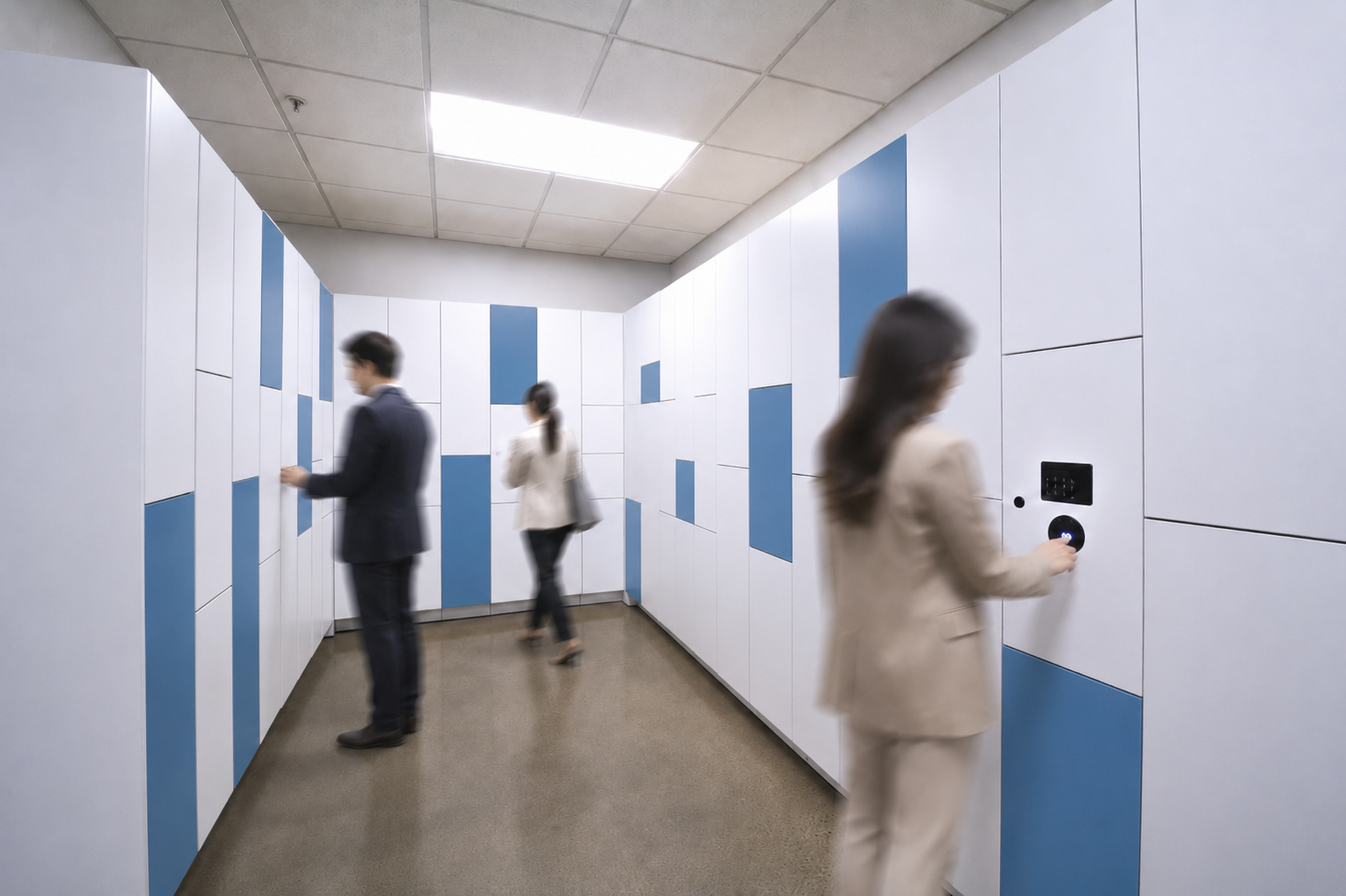
When planning personal lockers for employees in a hybrid workplace, the right quantity is rarely the same as the total headcount. A good calculation starts with peak attendance, the way lockers will be allocated, what people need to store and how demand changes across the week.
The objective is not simply to reduce the number of lockers. It is to provide enough convenient storage on the busiest realistic day, in the right locations and with a compartment mix that works for the people using it.
There is no universal ratio that suits every organisation. A workplace with predictable team days, good booking data and short day-use rules may support a lower locker-to-person ratio than a workplace with irregular attendance, permanently assigned storage or limited management controls.
Start with peak simultaneous demand
Total employee headcount is useful, but it is not the number that should drive the final locker quantity.
The more important figure is the highest number of people likely to need a locker at the same time.
That means looking beyond average attendance. A weekly average can hide a significant Tuesday, Wednesday or Thursday peak. If 350 people may attend on the busiest day, a design based on an average daily attendance of 240 could leave more than 100 people without suitable storage when demand is highest.
Useful evidence can include:
- Desk-booking and access-control data
- Team attendance policies
- Occupancy surveys
- Planned growth or consolidation
- Shift patterns and contractor numbers
- Visitor and project-team requirements
- Seasonal or event-driven peaks
Where reliable data is unavailable, it is better to agree a transparent planning assumption and test it with the workplace team than to rely on a generic industry ratio.
Decide how lockers will be allocated
The operating model has a major effect on quantity.
Permanently assigned lockers
A permanently assigned locker remains linked to one person, even when that person is working elsewhere.
This is simple for the user, but it normally requires more lockers because unused compartments cannot automatically be offered to somebody else. Permanent allocation may still be appropriate for people who attend frequently, need to retain specialist equipment or have an agreed workplace adjustment.
Day-use lockers
A day-use locker is selected or allocated when the employee arrives and released at the end of the permitted period.
This allows the same locker to serve different people on different days. It can reduce the overall quantity, but only if the release rules, user instructions and exception process are clear.
Pre-booked lockers
Pre-booking allows employees to reserve storage in advance, often alongside a desk, floor or workplace visit.
This can improve certainty and help teams understand future demand. The locker system may operate independently or exchange information with a workplace application where a suitable integration is available.
Mixed allocation
Many workplaces benefit from a mixture of permanent, bookable and day-use lockers.
For example, an organisation might retain permanent storage for a smaller defined group while most hybrid employees use a flexible pool. The important point is to calculate each group separately rather than applying one rule to everybody.
A practical calculation method
A useful starting calculation is:
Peak locker users + permanently assigned lockers + additional user groups + agreed contingency = planned locker quantity
Consider an organisation with:
- 500 employees in total
- 300 people expected on the busiest day
- 35 permanently assigned lockers for defined users
- 15 lockers required for contractors and visitors
- A 10% operational contingency applied to the flexible demand
If the 35 permanent users are already included within the 300-person peak, do not count them twice.
The flexible requirement would be 265 lockers. Adding 10% contingency gives approximately 292 flexible lockers. Adding the 35 permanent lockers and 15 additional-user lockers gives a planning quantity of approximately 342 lockers.
This is an example, not a recommended ratio. The correct inputs depend on the organisation, the building and the operating rules.
Separate the different user groups
Not everybody uses workplace storage in the same way.
The calculation may need to consider:
- Hybrid employees
- Full-time office-based employees
- Shift workers
- Contractors
- Visitors
- Project teams
- Executive or confidential-storage requirements
- Employees with accessibility needs
- Staff storing uniforms, PPE or specialist equipment
- Mailroom, IT or facilities teams using operational lockers
A single total can conceal these different requirements. Separating the groups makes it easier to agree the right allocation method and compartment size for each one.
Use the busiest days, not just the busiest building
Demand can vary by floor, department and location.
A building may have enough lockers overall but still create shortages if most users need storage close to a particular neighbourhood or floor. Asking people to travel through the building to find the only available locker can make a technically sufficient system feel inconvenient.
Capacity planning should therefore consider:
- Peak demand by floor or zone
- Where employees arrive and leave
- Proximity to desks, changing areas and circulation routes
- Whether teams move between neighbourhoods
- Whether a central bank or several distributed banks will work better
- Accessible approach routes and interface positions
Locker location can affect adoption just as much as locker quantity.
Choose the right mix of compartment sizes
Capacity is not only about the number of doors.
A bank containing 100 large compartments serves fewer people within the same wall space than a carefully planned mix of small, medium and large doors. The right layout starts with what users will actually store.
Typical workplace items might include:
- Laptop bags and backpacks
- Coats and personal belongings
- Motorcycle helmets
- Work equipment or tools
- Uniforms or PPE
- IT devices awaiting collection or return
Not every employee needs the largest compartment. A mixed layout can provide larger spaces where there is evidence of demand without sacrificing overall capacity.
This is explored further in Locker Lesson #1: Why Bigger Lockers Aren't Always Better.
Understand how the smart-locker rules affect capacity
Smart management can help facilities teams use the available estate more effectively, but software cannot compensate for an unrealistic quantity or poor location.
Useful operating rules can include:
- Automatic release at the end of a booking or day
- Reminders before a locker expires
- Administrator release of abandoned lockers
- Different time limits for different user groups
- Temporary blocking for faults or cleaning
- Live occupancy and availability reporting
- Historic utilisation reports by location and compartment size
The agreed rules should be communicated clearly. If users believe a day-use locker is permanent, or do not understand when belongings must be removed, the effective capacity will quickly reduce.
Allow a sensible contingency
Designing to exactly 100% of predicted demand leaves no room for normal variation.
Some contingency is usually sensible for:
- Attendance above forecast
- New starters and organisational growth
- Lockers temporarily unavailable for cleaning or repair
- Visitors, contractors and unexpected project teams
- Uneven demand between floors
- Employees needing a larger compartment than normal
The contingency does not need to be a hidden blanket percentage. It should be an agreed planning allowance based on the quality of the demand data and the operational risk of running short.
Plan for change without overbuilding
Hybrid-working policies can change. Teams expand, office layouts move and mobile-access strategies develop.
Useful future planning might include:
- Modular banks that can be extended
- Space and services reserved for later additions
- Reader technology selected around current and planned credentials
- Management software capable of supporting different allocation modes
- Replaceable control components
- Reviewing utilisation after occupation
The aim is to avoid buying unnecessary capacity on day one while keeping a practical route for future change.
Questions to answer before fixing the quantity
Before approving a locker schedule, ask:
- What is the total headcount?
- What is the realistic peak attendance by day, floor and team?
- Which users require permanent storage?
- Which users can share a flexible day-use pool?
- Are contractors and visitors included?
- What items will people store?
- How much larger-item capacity is genuinely required?
- Where should lockers be located?
- How will users authenticate?
- When and how will flexible lockers be released?
- Who handles exceptions, cleaning and abandoned belongings?
- What growth or contingency should be allowed?
- What data will be reviewed after launch?
Answering these questions produces a much stronger specification than starting with a fixed locker-to-employee ratio.
Frequently asked questions
Should every employee have their own locker?
Not always. Permanent lockers may be appropriate for defined users, but a managed flexible pool can serve hybrid employees who attend on different days. The decision should reflect attendance, storage needs, employee policy and the desired user experience.
What locker-to-employee ratio should we use?
There is no universal ratio. Calculate from peak simultaneous demand, permanent allocations, additional user groups, location and contingency. A ratio can be a sense check, but it should not replace the underlying evidence.
How much contingency should be included?
The allowance depends on the reliability of the attendance data, expected growth and the consequence of running short. It should also account for lockers temporarily unavailable and uneven demand between areas.
Can smart lockers reduce the quantity required?
They can help a flexible pool serve different people across the week by managing allocation, release and utilisation. The saving depends on user behaviour and clear operating rules. Smart technology does not remove the need for enough capacity on the busiest day.
Should lockers be centralised or distributed across floors?
Either can work. A central bank can simplify management, while distributed banks may be more convenient and better aligned with team demand. The building layout, circulation routes, available wall space and peak demand by area should guide the decision.
What happens if the organisation needs more lockers later?
The original design can consider modular expansion, reserved space and suitable power, data and containment. Utilisation reporting can then provide evidence for where additional capacity is needed.
The takeaway
The right number of lockers for a hybrid workplace is based on peak demand and operating rules, not total headcount alone.
Separate the user groups, understand the busiest days, choose a realistic compartment mix, locate the lockers conveniently and agree how flexible storage will be managed. Add a transparent contingency, then review actual utilisation once the workplace is operating.
Hublok supports workplace teams from early capacity planning through locker design, UK manufacture, smart technology, installation, commissioning and ongoing support.
Planning a hybrid workplace locker project?
Share your attendance assumptions, floor plans, user groups and storage requirements with Hublok. We can help turn them into a practical locker quantity, compartment mix and delivery brief.
Let's Talk