
Locker Lesson #4
The Best Locker Location Isn’t Always Where There’s Space
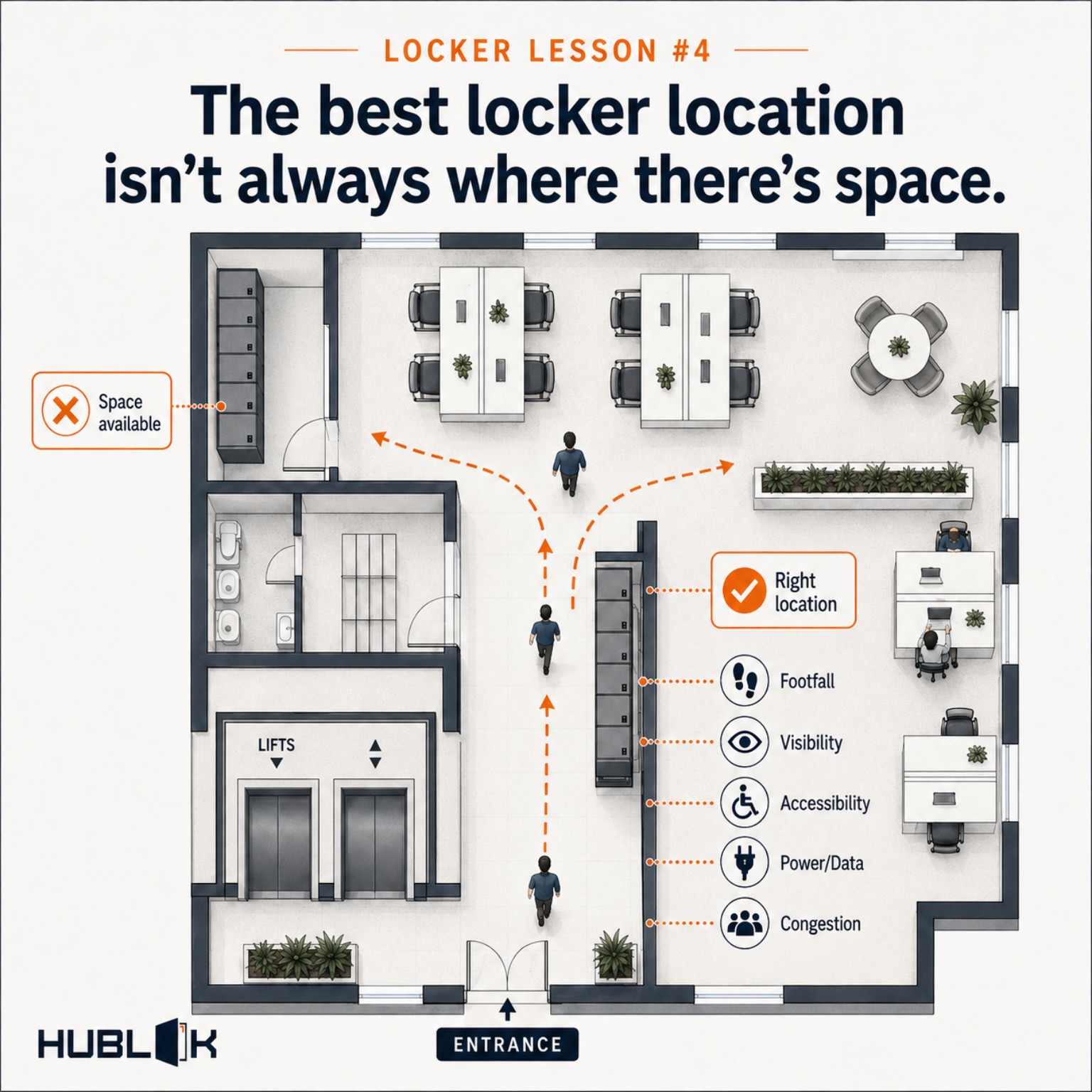
When planning a locker project, one of the first questions is often:
“Where have we got space for them?”
It is an understandable place to start.
But it probably shouldn’t be the deciding factor.
A locker bank can fit perfectly into an unused corner of a building and still be completely wrong for the people who need to use it.
The location of a locker system can have a surprisingly large impact on how successfully it is used.
Start with the user journey
Before deciding where lockers should go, think about how people naturally move through the building.
Where do they enter?
Where are they travelling to?
When are they most likely to need the locker?
A workplace locker hidden at the opposite end of the building from the main entrance may technically work, but users may simply find it inconvenient.
Likewise, parcel lockers positioned away from the natural route between the entrance, reception and workplace can add unnecessary steps to every collection.
The ideal locker location should feel like part of the user’s journey rather than a detour from it.
Footfall matters
High footfall is not necessarily a problem.
In many applications, it can actually be an advantage.
Positioning lockers close to a natural circulation route means users see them and can access them conveniently.
The important distinction is between being close to footfall and being in the way of footfall.
A good location provides convenient access without creating an obstruction.
Visibility is important
Smart lockers should usually be easy to find.
That might sound obvious, but locker banks are sometimes positioned in leftover spaces, behind walls or around corners simply because the furniture fits there.
If users regularly need signage or instructions just to find the lockers, it may be worth asking whether the location itself is right.
Visibility becomes particularly important in:
- Visitor environments
- Public venues
- Parcel collection areas
- Large workplaces
- Universities
- Leisure facilities
Good positioning can often simplify the whole user experience.
Think about accessibility
Accessibility should form part of the location decision from the beginning.
It is not simply about providing accessible locker compartments.
The route to the lockers, the space in front of them and the ability for different users to comfortably interact with the system all matter.
Consider:
- Clear circulation space
- Wheelchair access
- Reach heights
- Door opening space
- Interaction with screens or readers
- Nearby obstacles or furniture
A technically accessible locker can still be difficult to use if it is positioned badly.
Power and data need planning too
With smart lockers, the physical location can also influence the technology specification.
Depending on the system, considerations may include:
- Mains power
- Network connectivity
- Mobile connectivity
- Cable containment
- Network equipment
- Future maintenance access
These requirements are much easier to resolve when the locker position is considered early in the project.
Finding a perfect-looking location and then discovering there is no practical route for power or data can create unnecessary cost and compromise later.
What happens when several people arrive at once?
This is another reason why looking at an empty floorplan can be misleading.
A space may appear perfectly suitable until several users are standing in front of the lockers at the same time.
This links closely with Locker Lesson #3 – Don’t Design Smart Lockers for the Average Day.
Think about the busiest period.
Will people queue?
Will they block a corridor?
Could an open locker door obstruct another circulation route?
Could several users comfortably interact with the system simultaneously?
The space around the lockers can be just as important as the lockers themselves.
Sometimes a few metres makes a big difference
The interesting thing is that the best location does not necessarily require a completely different part of the building.
Sometimes moving a locker bank just a few metres can improve:
- Visibility
- Convenience
- Accessibility
- User flow
- Connectivity
- Overall utilisation
That is why we believe locker location should be considered as part of the specification rather than simply decided once the remaining floor space is known.
The takeaway
The best locker location is not necessarily the place where the lockers fit most easily.
It is the location that works best for the people using them and for the building around them.
Consider the user journey.
Consider footfall.
Consider visibility.
Consider accessibility.
Consider power and data.
And consider what happens when the area becomes busy.
Available space doesn’t always mean the right space.